
Destiny 2 PvE Guide: Every Activity in the Final Sandbox
Every Destiny 2 PvE Activity Explained: What to Play and What to Earn
Over the past few days, we’ve received plenty of questions from Guardians wondering what they should be doing in Destiny 2 PvE. With the current sandbox offering a wide variety of activities, there isn’t a single correct way to play the game. Your goals may be leveling up, earning powerful gear, improving your build, collecting Exotic weapons, completing challenging endgame content, or simply exploring everything Destiny 2 has to offer.
To help you get started, we’ve put together this Destiny 2 PvE Guide covering the most important activities worth playing and the types of rewards you can earn from them. Whether you’re a new player, a returning Guardian, or an experienced player looking for your next challenge, this guide will help you decide what to do and where to focus your time.
You load into a Grandmaster with a build you copied from a guide, and nothing works the way it promised. The artifact mod it told you to slot does not exist. The Nightfall node it told you to find is gone. Wasted evenings add up fast when your reference material is describing a version of the game that no longer runs. This Destiny 2 PvE guide is written against the sandbox as it actually stands.
Table of Contents
What Counts as PvE in Destiny 2 Now
Why Most Destiny 2 PvE Guides Are Now Wrong
The Six Difficulty Tiers and What They Pay
Every PvE Activity Type, by Commitment
Reading the Health Bar Before You Shoot
Building a Guardian for a Sandbox That Never Changes
A Progression Plan With No Expiry Date
Mistakes That Still Wipe Fireteams
Key Takeaways
Frequently Asked Questions
What Counts as PvE in Destiny 2 Now
PvE covers everything you play against the game rather than against other Guardians, and it is the overwhelming majority of Destiny 2. The awkward part is that it is no longer stored in one place.
Content splits across two shelves. The Director's Portal Ops hub holds the newer, customisable activities from The Edge of Fate and Renegades. The older destinations and their activities sit on their own nodes, covering everything that shipped up through The Final Shape. That split is nine years of expansions stacked on top of each other, which our Destiny 2 release history traces in order.
Bungie's own activities breakdown groups the Portal into launchable categories. Four of them are pure PvE: Solo Ops, Fireteam Ops, Arena Ops, and Pinnacle Ops. Crucible Ops is the PvP node, and Gambit Ops mixes both.
Alongside that sit raids, dungeons, Exotic missions, patrol destinations, and Pantheon. None of those live inside the Portal categories, which is exactly why so many players bounce off the menus and assume there is less to do than there is.
The Destiny 2 Director, where Portal Ops holds the newer customisable PvE activities and the older destinations sit on separate nodes.
Why Most Destiny 2 PvE Guides Are Now Wrong
The Monument of Triumph update, shipped as Update 9.7.0 on 9 June 2026, was Destiny 2's final live-service content update. Bungie has said the game receives no further planned content, only occasional hotfixes for stability. The sandbox you are playing is the sandbox forever.
That update also deleted things. Per Bungie's 9.7.0 support guide, the legacy Vanguard Ops playlist and the Nightfall nodes were deprecated, with those activities folded into the Fireteam Ops hub. The Legends node was deprecated too, so Exotic missions, raids and dungeons now launch from Pinnacle Ops or the Raids and Dungeons node.
Four seasonal events were retired outright: Guardian Games, Solstice, Festival of the Lost and The Dawning. Some of their rewards moved elsewhere, into Eververse and the Monument of Guardian Tenets.
So if a guide tells you to queue a Grandmaster Nightfall, check the Legends node, or farm Solstice armour, it is describing a build of the game that stopped existing. We have seen guides updated this month that still do.
Three specific reversals are worth knowing, because they change what you actually equip:
Champion counters are no longer gated behind seasonal artifact mods. Weapon archetypes now carry the stun intrinsically.
Resilience, Recovery, Discipline and Intellect no longer exist. Armour stats were rebuilt around Health, Melee, Grenade, Super, Class and Weapons.
Special and Heavy ammo no longer drop simply from kills. You fill generation bars on your HUD, and your Weapons stat sets how fast they fill.
Bungie confirms the ammo and stat changes directly in its Monument of Triumph FAQ. If your loadout logic predates those, it is working from the wrong model.
The Six Difficulty Tiers and What They Pay
Portal activities let you dial difficulty yourself, and the payout is deterministic rather than mysterious. Bungie publishes the mapping in its Director guide:
DifficultyReward RankReward TierNormalCTier 1AdvancedBTier 2ExpertATier 3MasterA+Tier 4GrandmasterSTier 5UltimateS+Tier 5
Higher tiers matter because gear tier is not cosmetic. Tier 5 armour gains an extra mod socket, and Tier 5 weapons unlock traits that lower tiers never see.
Here is the part almost nobody points out. Destination public events pay Tier 3 on a base completion and Tier 4 for a Heroic version, with a chance to roll up to Tier 5, and a Distortion bumps those rewards by a further tier.
Compare that against the Portal table. On gear tier alone, a Heroic public event in a patrol zone out-rewards an Expert Portal run. Portal difficulty still wins on score, currencies and Power progression, so it is not a free lunch. But if you are farming for Tier 4 armour specifically and Grandmaster is out of reach, the patrol zone is a genuine route rather than a consolation prize.
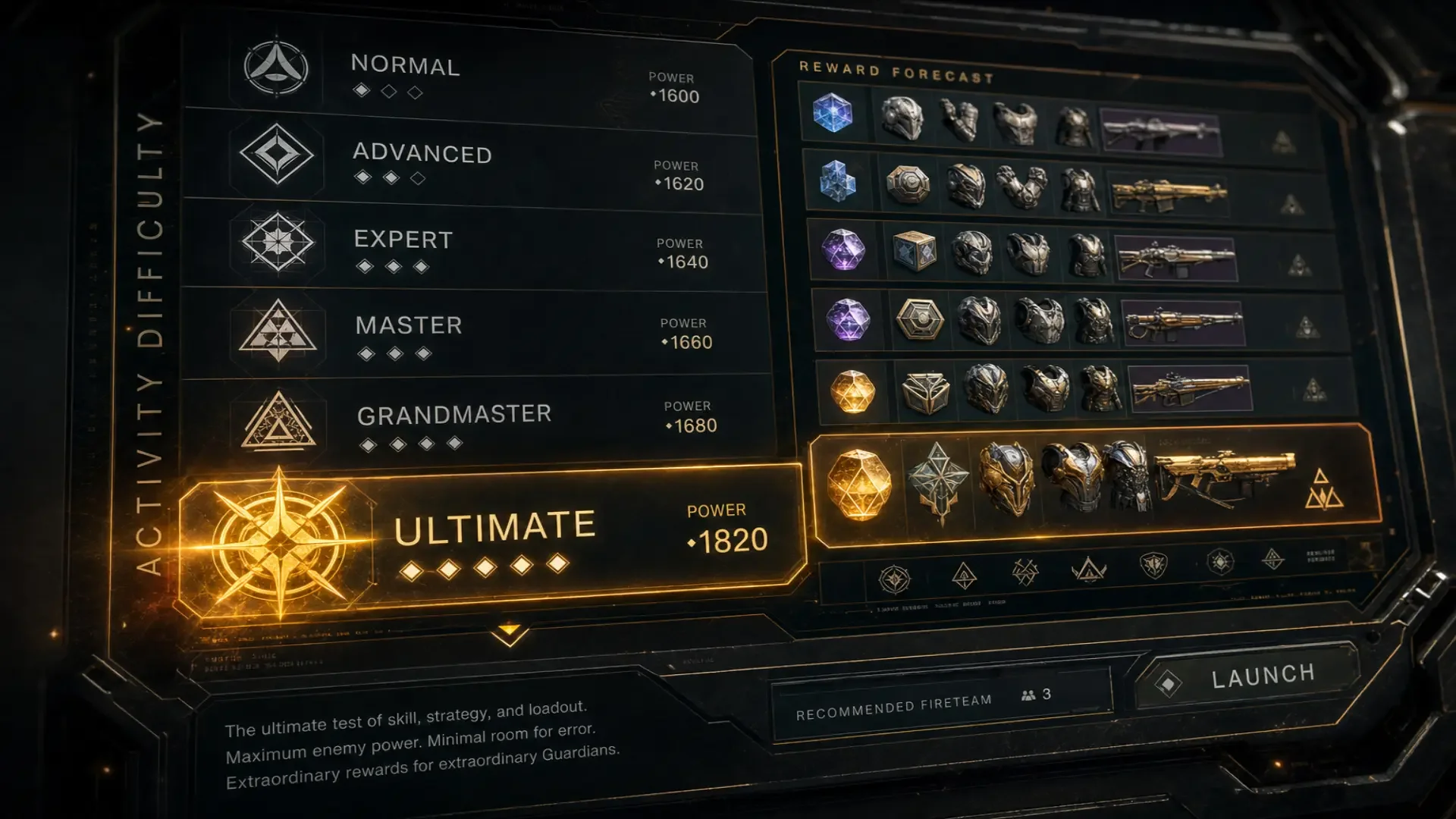
Portal difficulty selection in Destiny 2, running from Normal at Tier 1 up to Grandmaster and Ultimate at Tier 5.
Every PvE Activity Type, by Commitment
Solo Ops
Single-player slices of destinations you have already visited, with adjustable difficulty and modifiers. This is the lowest-friction PvE in the game and the best place to test a build before you inflict it on a fireteam.
Fireteam Ops
Three-player content, some matchmade and some requiring a pre-formed group. Strikes, Battlegrounds, Expeditions and Reclaims all live here now, which is where the old Vanguard Ops playlist went. Quickplay and Grandmaster runs both feed Weekly Challenges.
Arena Ops
Six-player activities pulled from past seasons, currently covering Arena Ops, Astral Alignment and Nightmare Containment. All of them matchmake. If you want loud, uncomplicated PvE with strangers, this is it.
Pinnacle Ops and Exotic Missions
Three-player endgame with a unique loot pool, longer runtimes and real mechanical complexity. Exotic missions count as Pinnacle Ops, and Bungie's published list runs to sixteen, from The Whisper and Zero Hour through to Derealize, Heliostat and Fire and Ice.
Some are locked behind campaign progress. The Whisper is open to everyone; Fire and Ice needs Renegades progression. Two of the trickier recent ones are covered in our Heliostat mission guide and Derealize walkthrough.
That sixteen is not the whole picture. Update 9.7.0 also shipped the Oblation chain, three linked Exotic missions on the Moon that arrived with no announcement and do not appear on Bungie's list. Clearing them rewards Cull's Shadow, and finishing the whole chain on the timed Master run earns the Darkest Depths triumph.
Dungeons
Three-player endgame with heavy mechanics, at least one punishing boss, and loot that drops nowhere else. Eleven exist: The Shattered Throne, Pit of Heresy, Prophecy, Grasp of Avarice, Duality, Spire of the Watcher, Ghost of the Deep, Warlord's Ruin, Vesper's Host, Sundered Doctrine and Equilibrium.
Most carry a solo completion challenge, which is where a lot of players find their personal ceiling. Equilibrium is the newest of them, and our Equilibrium dungeon guide breaks down its encounters.
Raids
Six-player, mechanically dense, and the top of the PvE pile. Ten are live: Last Wish, Garden of Salvation, Deep Stone Crypt, Vault of Glass, Vow of the Disciple, King's Fall, Root of Nightmares, Crota's End, Salvation's Edge and The Desert Perpetual.
Each one hides an Exotic weapon, sometimes on a random drop and sometimes behind a long quest chain. Vault of Glass, King's Fall and Crota's End are available without an expansion purchase, which makes them the natural first raids for anyone starting from free-to-play.
Pantheon and Seasonal Conquests
Pantheon returned as a permanent activity in 9.7.0, cycling raid bosses through rotating encounters. Seasonal Conquests are curated escalating challenges with fixed modifiers, and clearing the set earns the Conqueror Title. Conquests no longer reset, so there is no urgency to rush them.
Destinations and Distortions
Thirteen destinations sit on the Director, from the Tower social hub through to Kepler, Lawless Frontier, The Pale Heart and Eternity. The combat destinations carry Lost Sectors, public events and location-specific activities.
Plenty of older locations are missing from that list, and the vaulted Destiny 2 areas are now reachable only through unofficial means.
Distortions rotate hourly, corrupting one destination at a time. Enemies get tougher and more aggressive, and rewards climb a tier to match. Lawless Frontier also runs its own progression track on top of that, including Praxic Blade customisation.
Raids sit at the top of Destiny 2's PvE ladder: ten are currently available, each built for a fireteam of six.
Reading the Health Bar Before You Shoot
Target priority is the single largest skill gap between players who clear Grandmasters and players who do not. Bungie's enemies overview sets out the hierarchy, and the health bar tells you everything.
Red bars are rank-and-file minors. Primary ammo, no thought required.
Orange or yellow bars are elites. Special ammo is more efficient here.
Yellow bars with a name and a triangle icon are majors. Tougher, but no special defeat condition.
Yellow or silver bars with a diamond icon and a screen-wide bar are bosses.
Dark red tendrils and black plating mark Champions.
Banes are enemies carrying a special modifier condition, identified through the Portal activity's modifiers.
Champions come in three kinds, and this is the mechanic old guides most reliably get backwards.
Barrier Champions raise an impenetrable shield after taking damage. Precision and Adaptive frames stun them intrinsically, as do Caster Swords, Disruption Sniper Rifles and legacy PR-55 Pulse Rifles.
Barrier is the one to double-check. Bungie's new-player page still lists Radiant, Volatile Rounds and Unravelling Rounds as Barrier stuns, while community documentation of the 9.7.0 notes reports those verbs were changed to grant bonus damage against Champions instead of stunning them. Until that resolves, treat a weapon frame as your Barrier answer rather than a subclass verb.
Overload Champions regenerate heavily and attack on short cooldowns. Lightweight and Rapid-Fire frames handle them, along with Support Frame Auto Rifles, Area Denial Grenade Launchers, Spread Shot Hand Cannons and Vortex Swords. Elementally, use Slow, Jolt or Suppress.
Unstoppable Champions charge you until staggered. Aggressive and High Impact frames stun them, plus several Grenade Launcher frames, Heavy Burst Hand Cannons, Aggressive Burst SMGs and Pulse Rifles, and Wave Swords. Elementally, use Shatter, Blind, Ignition or Suspend.
Those frame lists are longer than the shortlists above, so check Bungie's page for the full set before a Grandmaster. The point that matters is the shift: you now build a Champion answer from archetypes and subclass verbs you own permanently, not from a rotating artifact you have to re-earn.
Champions come in Barrier, Overload and Unstoppable variants, now countered through weapon archetypes rather than seasonal artifact mods.
Building a Guardian for a Sandbox That Never Changes
Pick a subclass by verb, not by vibe
Six subclasses exist: Solar, Arc, Void, Stasis, Strand and Prismatic. Every class can use all of them, and the practical difference in PvE is which buffs, debuffs and constructs you get access to.
Solar heals and burns. Arc amplifies and blinds. Void grants Devour, invisibility and overshields. Stasis freezes and shatters. Strand suspends and severs. Prismatic mixes Light and Darkness with a Transcendence state on top. A handful of Exotics cut across those lines entirely: the Dead Messenger Exotic cycles Void, Solar and Arc from a single slot.
Access rules are worth checking before you commit. Stasis needs the Beyond Light campaign on Europa, which is free to all players. Strand requires Lightfall, and Prismatic requires The Final Shape.
Aspects and Fragments are where builds actually form. You equip two Aspects, and each opens two or three Fragment slots. Arc, Solar and Void Aspects come from Ikora for Glimmer, Stasis from the Exo Stranger on Europa, Strand from the Pouka Pond on Neomuna, and Prismatic from missions in The Pale Heart.
Update 9.7.0 added three final Aspects to the pool: Shieldburst, Crackshot and Soul Siphon. Because nothing further is planned, these are permanent additions rather than a seasonal experiment.
The armour stats that carry your build
Six stats replaced the old set: Health, Melee, Grenade, Super, Class and Weapons. Each runs to 200 rather than 100, and crossing the 100 mark changes what the stat does rather than just giving you more of it.
Below 100, Melee, Grenade and Super shorten cooldowns and improve the energy you gain from external sources. Above 100, those three start adding raw ability damage. Class is the exception: past 100 it grants an overshield when you cast your class ability rather than more damage.
Health below 100 governs how much you heal from Orbs of Power and your flinch resistance; above 100 it improves shield recharge speed and capacity.
Weapons is the stat people skip and should not. It sets how quickly your Special and Heavy ammo generation bars fill, which in a long boss fight is the difference between three damage phases and five.
Comparing stat spreads across a full vault is painful in-game. Using Destiny Item Manager loadouts makes the sorting far faster.
Set bonuses and gear tiers
Armour set bonuses activate at two and four matching pieces. You can run four of one set for the stronger effect, or two plus two for breadth, and your Exotic slot is unaffected either way.
Gear from New Light through The Final Shape sits outside the Tier system. It still works, and there is no reason to bin a weapon you love, but it will not reach Tier 5 perks or sockets.
Artifacts are now a permanent choice
Rather than a single rotating seasonal artifact, Monument of Triumph brought back a set of legacy artifacts spanning Season of the Deep through Renegades under a reworked Artifacts 2.0 system. Perk selection is simplified, artifact choices save to your Loadouts, and because no new season is coming, whichever you pick stays valid indefinitely.
One warning for anyone reading mid-June 2026 content: the artifact perk duplication exploit that briefly allowed the same perk seven times over was closed in hotfix 9.7.0.2 on 23 June 2026, one of the final Destiny 2 patches Bungie shipped. Guides recommending seven-stack damage builds are describing a two-week window that has shut.
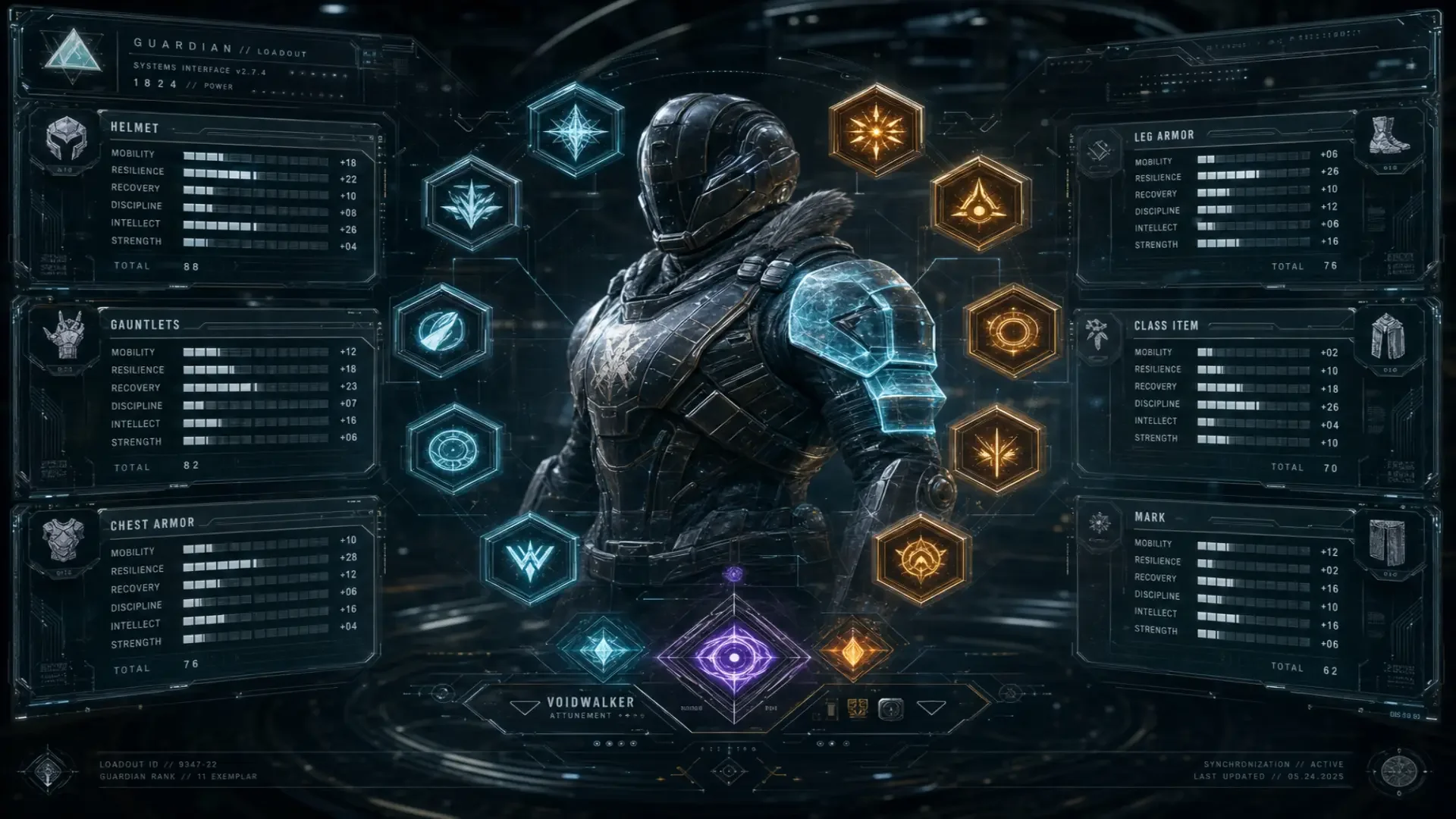
Armour uses six stats scaling to 200, where crossing the 100 mark changes what each stat does rather than simply adding more of it.
A Progression Plan With No Expiry Date
Power runs from 10 to a hard cap of 550, and Bungie confirmed in the Monument of Triumph FAQ that the cap is not rising again. New and returning Guardians start at 10, but loot begins dropping at 300 and above as a catch-up mechanism, so the early climb is fast.
The important consequence is strategic. In a live-service game you chase the current season because last season's investment decays. Nothing decays now. Time spent perfecting one loadout is time you keep.
That argues for a different order of operations than most guides recommend:
Clear the New Light quest for baseline gear and orientation.
Push Power to roughly 300 through any content at all, since almost everything drops at that floor.
Unlock your subclasses, prioritising Stasis because Beyond Light is free.
Run Solo Ops and Fireteam Ops at Advanced or Expert to build a functioning loadout.
Pick one dungeon and learn it properly rather than sampling five.
Move into raids and Grandmaster content once your build survives without constant revives.
Vendor reputation now comes from playing activities and completing destination missions rather than stacking bounties, since most bounties were deprecated outside destination and clan versions. Legendary Shards and planetary materials were deprecated and are no longer needed for infusion, though leftovers can still be exchanged with Rahool in the Tower.
Guardian Ranks are worth a look early because completing them permanently unlocks features such as Loadout slots and armour modifications.
Mistakes That Still Wipe Fireteams
Chasing 550 before touching endgame. Raids and dungeons are clearable well below the cap, and the climb from 300 upward is fast enough that gatekeeping yourself wastes more time than it saves.
Ignoring the Weapons stat. If your Heavy bar never fills, your damage phase ends early regardless of what you are holding.
Bringing three copies of the same Champion answer. Grandmasters mix Champion types, and a fireteam that all built for Barrier will stall on the first Overload.
Treating Prismatic as automatically correct. It is one subclass of six, and your Aspect pairing decides far more about a build's output than the subclass label above it.
Skipping Fireteam Finder. The in-game LFG tool sits on the roster screen and removes most of the friction that stops players attempting raids at all.
Coordinating Champion counters across a fireteam before launching, since Grandmaster activities mix all three Champion types.
Key Takeaways
Destiny 2's sandbox was frozen by Update 9.7.0 on 9 June 2026, so build investment no longer decays between seasons.
Nightfall and Legends nodes were deprecated; those activities now live in Fireteam Ops, Pinnacle Ops, and the Raids and Dungeons node.
Champion stuns come from weapon archetypes and subclass verbs, not from seasonal artifact mods.
Portal difficulty maps cleanly to reward tier, from Normal at Tier 1 to Grandmaster and Ultimate at Tier 5.
Heroic public events pay Tier 4 gear, which beats an Expert Portal run on tier alone.
Armour uses six stats to 200, with the 100 mark changing what each stat does.
Ten raids, eleven dungeons and sixteen listed Exotic missions are available, plus the unlisted Oblation chain.
Power caps at 550 and is not increasing again.
Frequently Asked Questions
What is PvE in Destiny 2?
PvE stands for player versus environment and covers every activity where you fight AI enemies rather than other Guardians. That includes campaigns, strikes, dungeons, raids, Exotic missions and patrol content. It makes up the large majority of Destiny 2's content.
Is Destiny 2 still worth playing in 2026?
Yes, if you want a finished game rather than a live one. All content remains playable indefinitely following Update 9.7.0, and the full back catalogue of raids, dungeons and campaigns is intact. What you will not get is new seasonal content. Our Destiny 2 player counts breakdown has the current numbers.
What happened to Nightfalls in Destiny 2?
The legacy Nightfall nodes were deprecated in Update 9.7.0. Those activities were folded into the Fireteam Ops hub, where Grandmaster difficulty is still available. Grandmaster Vanguard Alerts now fill the role the old Grandmaster Nightfalls did.
How many raids and dungeons does Destiny 2 have?
Ten raids and eleven dungeons are currently available. Access to specific ones depends on owning the matching expansion or Dungeon Key, though Vault of Glass, King's Fall and Crota's End are open to all players.
What is the max Power level in Destiny 2?
The Power cap is 550 and Bungie has confirmed it will not increase again. Guardians start at 10, but gear drops at 300 and above as a catch-up mechanism, so the early climb takes far less time than the number suggests.
How do I stun Champions in Destiny 2?
Weapon archetypes now carry Champion stuns intrinsically rather than requiring artifact mods. Precision and Adaptive frames handle Barrier, Lightweight and Rapid-Fire frames handle Overload, and Aggressive and High Impact frames handle Unstoppable. Subclass verbs such as Jolt, Suspend and Ignition also stun.
What is the best class for PvE in Destiny 2?
All three classes clear all PvE content, so the honest answer is whichever playstyle you enjoy. Titans lean into survivability and melee loops, Hunters into single-target burst damage, and Warlocks into sustain and ability uptime. Your Aspects matter far more than your class choice.
Which subclass should I use for PvE?
Void is the most forgiving because Devour and overshields keep you alive through mistakes. Solar offers healing plus ignition damage, and Prismatic gives breadth once you own The Final Shape. Stasis is the strongest free option since Beyond Light costs nothing.
How do I get Special and Heavy ammo in Destiny 2?
Special and Heavy ammo drop when you fill their generation bars, shown at the bottom left of your HUD below your weapon and ability icons. Your Weapons armour stat determines how quickly those bars fill. Raising it with armour mods directly increases your ammo economy.
Do I need to buy expansions to play Destiny 2 PvE?
No. Destiny 2 is free to play, and the free tier includes the Beyond Light campaign on Europa, Exotic missions such as The Whisper, and raids including Vault of Glass, King's Fall and Crota's End. Expansions unlock additional destinations, subclasses such as Strand and Prismatic, and their associated endgame content.
Can you solo Destiny 2 endgame content?
Yes, within limits. Solo Ops is built for it, most dungeons carry a dedicated solo completion challenge, and plenty of players solo them. Raids are built for six, and their mechanics generally rule out a solo clear.